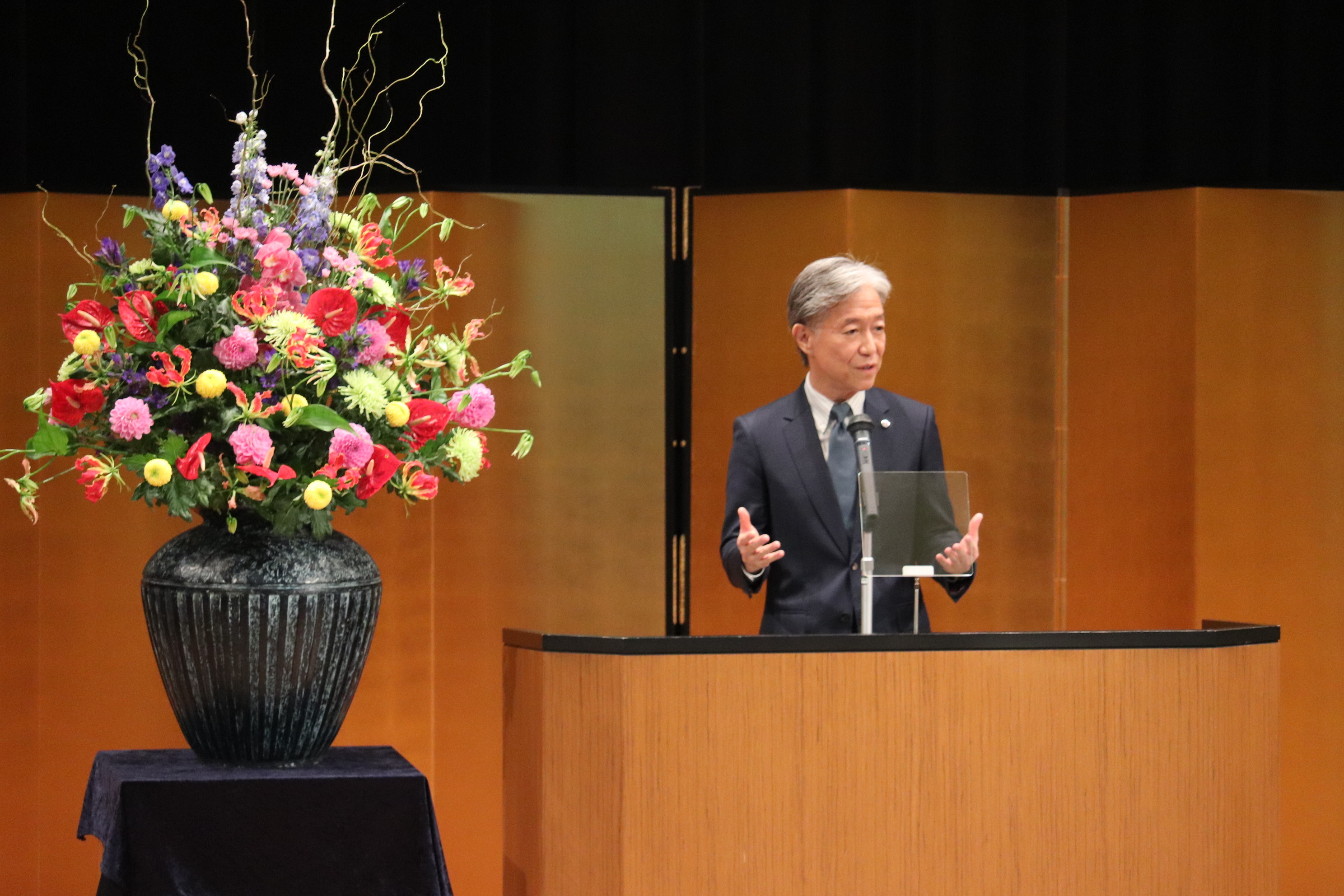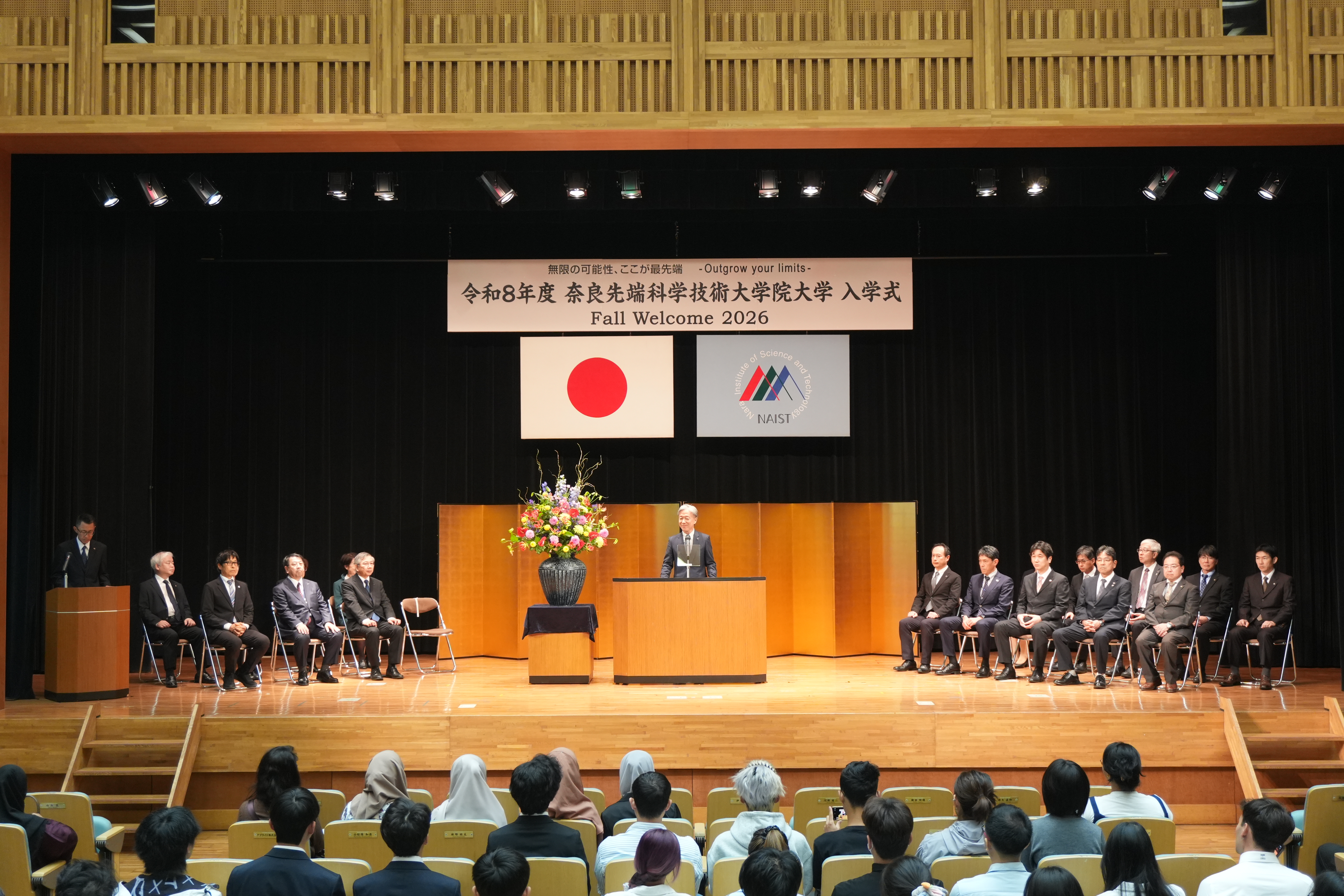
10月2日(金曜日)、ミレニアムホールにおいて令和8年度秋学期入学式を挙行しました。
本学では、国内外を問わず、また出身大学での専攻にとらわれず、高い基礎学力を持った学生あるいは社会で活躍中の研究者・技術者などで、将来に対する明確な目標と志、先端科学技術分野に対する強い興味と意欲を持った者の入学を積極的に進めており、このたび、102名の新入生を本学に迎えました。
【入学者数】
(博士前期課程)
先端科学技術研究科 50名(うち留学生46名)
(博士後期課程)
先端科学技術研究科 52名(うち留学生44名)
総計 102名(うち留学生90名)
【塩﨑学長式辞】
Fall Welcome 2026
Hello, everyone. On behalf of the faculty and staff of the Nara Institute of Science and Technology, NAIST for short, I am delighted to welcome you all as you embark on your postgraduate studies here. I would also like to extend my sincere congratulations to your families.
Our faculty and staff are proud that you have chosen NAIST as a place for your studies. NAIST is a unique university with distinctive features and strengths. Above all, there are no undergraduate programs here. We admit graduates from diverse universities and technical colleges, and many international students are joining NAIST as well. Indeed, about one out of every four students at NAIST are international. Today, we welcome 102 new students from 24 countries and regions, including Japan.
As a university community rich in diversity, NAIST declared in 2022 that it is a "co-creative community." Our "Declaration of Co-creative Community" says:
"The Co-creative Community we aspire to is a community where members
strive for the creation of new value through the exchange of opinions with
courtesy and empathy. We value our individual differences and pursue mutual
understanding and respect while rejecting discrimination."
The entire Declaration is on our university website and also posted at the entrance of each Division building. Please make time to read it.
As you just heard, the Declaration says, 'we value our individual differences.' Indeed, in the era of AI, individual differences are becoming increasingly important. Recent studies indicate that generative AI tends to reduce the diversity of ideas. For example, a paper reported last year a large-scale analysis of scientific literature, which found that, since the release of ChatGPT in late 2022, the number of papers per author has increased. At the same time, content and linguistic similarity have also increased.
Another study published earlier this year found that the widespread use of large language models (LLMs) as writing assistants is linked to reduced writing complexity that signifies writers' personality, cultural background, and demographics. This phenomenon may stem from the "homogenization" of AI output, driven by limited diversity in the data used to train AI models or in how they are trained. But AI is not the only thing to blame. We also tend to look to AI output as representative of broader views or the best expertise of today. A growing body of studies now makes researchers worry that generative AI and the way we use it may homogenize our culture and cognition.
Some say we don't need to worry too much about it, since it is yet another "McDonaldization." Have you ever heard the word McDonaldization? The word was coined by George Ritzer, an American sociologist. He pointed out that globalization in the 20th century caused cultural homogenization where the principles of fast-food chains, such as efficiency and predictability, prevailed. But so far, cultures seem quite resistant to the homogenizing effect of globalization. On the other hand, given the scale of AI adoption in our society, its impact could go far beyond globalization.
I believe many of you are using AI every day in one way or another. If you use AI to think, create, and behave just like everyone else, you'll likely receive no more recognition than the majority does. As you know, in the job market, you will be evaluated more by the relationship between supply and demand than by the intrinsic value of your abilities or knowledge. What matters is becoming a sought-after, rare talent.
Also in research, being different is critical, and today you have joined NAIST, a unique research university that strives to reach frontiers where nobody has yet arrived. I want you to know that our university's Japanese name includes the word "Sentan," meaning "cutting-edge." To be at the cutting edge of science, the NAIST community welcomes you who bring different perspectives, ideas, experiences, and approaches. Our Declaration of Co-creative Community says, "We affirm that the different ways of thinking and various experiences of our community members support multi-faceted perspectives and unique approaches," which are essential to cutting-edge research.
One more thing, before I close. Let me introduce our school motto to those new to our campus:
"Outgrow your limits."
That's our university motto.
"Outgrow your limits."
I want you to remember that you don't know your full potential yet. Don't set limits on yourself. NAIST has a remarkable environment for you to "outgrow your limits" beyond what you think your limits are. We urge you to take advantage of this extraordinary environment. You can find endless opportunities to get involved with projects and diverse people whose interests align with yours. Our faculty is a group of world-class researchers who are looking forward to collaborating with you.
I cannot wait to see how you develop and what you achieve at NAIST to make the world a better place.
Have fun and outgrow your limits!
※参考 日本語訳
実際の式辞は英語で行われました。
2026年10月入学式 学長式辞
こんにちは。奈良先端科学技術大学院大学(NAIST)の教職員を代表し、本学で大学院の学びをスタートする皆さんを歓迎します。また、ご家族にも心よりお祝いを申し上げます。
教職員一同、皆さんが学びの場としてNAISTを選んでくださったことを誇りに思います。NAISTは、特色と強みを持つ他にはない大学です。まず、本学には学部がありません。さまざまな大学や高等専門学校の卒業生を受け入れており、また多くの留学生も本学で学んでいます。実に学生の約4人に1人は留学生です。そして本日また、日本を含む24の国・地域から102名の新入生を本学に迎えます。
このように多様性に富んだ大学コミュニティとして、本学は2022年に「共創コミュニティー」であることを宣言しました。この「共創コミュニティー宣言」では、次のように述べられています:
「本学が目指す「共創コミュニティー」とは、私たち構成員の各自が互いの多様性を認識し、相互の理解と尊重に努めるとともに、差別を認めず、相手に対する敬意と思いやりの下での意見交換をとおして、新たな価値の創造を目指す共同体です。」
宣言の全文は、本学ウェブサイトに掲載されているほか、各領域棟の入口にも掲示されています。ぜひ一度、目を通してください。
さて、今、読み上げたように、この宣言には「私たち構成員の各自が互いの多様性を認識し」とあります。今、このAI時代においては、一人ひとりの違いがますます重要になっています。最近の研究によると、生成AIは発想の多様性を低下させる傾向があることが示されています。例えば、昨年発表されたある論文で報告された科学文献の大規模調査によると、2022年末にChatGPTが登場して以降、著者1人あたりの論文数は増加したものの、論文の内容や言語表現の類似性が高まっていることが明らかになりました。
今年初めに発表された別の研究によると、大規模言語モデル(LLM)による文章作成補助アプリの利用拡大が、書き手の個性や文化的背景、人口統計学上の属性などが現れる文章の複雑性の低下につながっているとのことです。この現象の背景には、AIモデルの学習に使用されるデータの多様性が限られていることや、AIモデルの学習方法そのものに起因する、AIからの出力の「均質化」があるのかもしれません。しかし、AIだけを悪者にするわけにもいきません。私たち自身、AIの出す答えを幅広い意見の代表的なものとみなしたり、現時点で最善の専門知識であると考えてしまう傾向があります。さまざまな研究が進むにつれ、生成AIとその利用方法が私たちの文化や認知を均質化してしまうのではないかと、研究者たちは懸念しています。
一方で、これは例によって「マクドナルド化」のような話に過ぎないのだから、それほど心配する必要はないという意見もあります。皆さんは、「マクドナルド化」という言葉をご存じですか。アメリカの社会学者George Ritzerが使った言葉なのですが、20世紀に急速に進んだグローバル化によって、ファストフード・チェーンのように効率性や予測可能性を重視する原理が世界中で幅を利かせるようになり、文化の均質化が進むだろうとRitzerは指摘しました。しかし、見たところ、グローバル化による世界の文化の均質化はそれほど進んでいないように思えます。しかしながら、今のAIの大規模な普及からすれば、その影響はグローバル化をはるかに超えるものになる可能性があります。
皆さんも、何らかの形で毎日AIを使っているのではないでしょうか。もし、AIを使うことで他の人と同じように考え、創造し、行動することになれば、おそらく他の大多数の人と同じ評価しか得られないことになるでしょう。というのも、労働市場では、能力や知識そのものの価値よりも、需要と供給の関係によって評価が決まるからです。ですから重要なのは、他の人とは違う、求められる希少な人材になることです。
研究においても、他とは違うということが極めて重要です。今日、皆さんは、未開拓の領域を目指し続ける、ユニークな研究大学である本学に入学しました。本学の日本語名には「先端」という言葉が含まれているということはご存知でしょうか。科学の最先端に立つために、NAISTコミュニティは異なる視点、発想、経験、アプローチをもつ皆さんを歓迎します。先ほどご紹介した「共創コミュニティー宣言」には、次のように記されています:
「私たちは、構成員の様々な考え方や経験が、多角的な視点や多彩な発想の源になることを確信します。」
この「多角的な視点や多彩な発想」こそ、最先端の研究を行うために不可欠なものなのです。
最後に、本日入学の皆さんに、本学の校訓を紹介しておきます。
"Outgrow your limits"
「自らの限界を超えよう」という意味です。
皆さんは、自身の可能性を知り尽くしているわけではありません。また、自分で限界を決めてしまうことも避けるべきです。皆さんの思う「自分の限界」を超えるための素晴らしい環境がNAISTには揃っていますから、それを大いに活用してください。それぞれの興味に合うような様々なプロジェクトや、多様な人々と関わることができる、数え切れない機会がここにはあります。世界トップクラスの研究者である本学の教員も、皆さんと共に研究に取り組むことを心待ちにしています。
皆さんが本学でどのように成長し、何を成し遂げ、そしてより良い世界の実現にどのように貢献していくのか、今から楽しみです。
Have fun and outgrow your limits!
2026年10月2日
奈良先端科学技術大学院大学
学長 塩﨑 一裕